GY-302 BH1750 Light Intensity Sensor Review: Is This Tiny Module Worth Your Time?
We’ve all been there. You’re working on an Arduino project—maybe an automatic lighting system for your house or a smart greenhouse for your backyard—and you realize you need a way to measure exactly how much light is hitting your plants or your living room. You could try using a cheap photoresistor (LDR), but they are notoriously finicky, inaccurate, and sensitive to temperature changes.
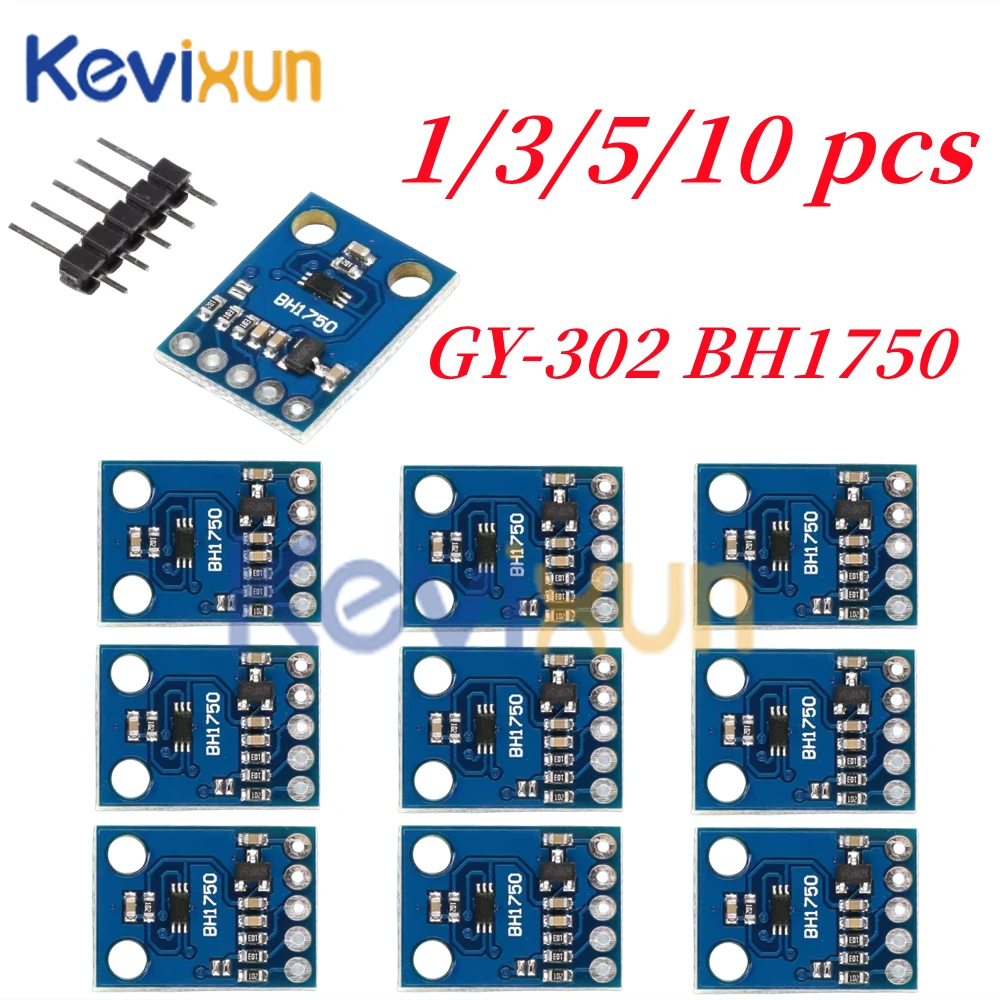
That’s where the 10pcs/1pc GY-302 BH1750 BH1750FVI Light Intensity Illumination Module Digital Optical Intensity Illumination Sensor for Arduino comes in. If you are tired of guessing light levels and want actual, readable data, this little module is usually the first step up. But is it actually good, or just another piece of cheap electronics that ends up in your junk drawer? Let’s take a look.
What is the GY-302 BH1750 Light Intensity Sensor?
In simple terms, the GY-302 is a small breakout board that houses the BH1750FVI chip. Unlike an old-school analog light sensor that gives you a vague voltage reading, this module does the math for you. It uses a digital interface (I2C) to talk to your Arduino, Raspberry Pi, or ESP32, and it spits out a value in lux—the actual unit of light intensity used by scientists and engineers.
The biggest appeal here is how budget-friendly it is. Whether you pick up a single unit for a quick fix or a 10-pack for a larger deployment, these modules are incredibly cheap. You can often find them online with free shipping, making them an easy “add-on” to your cart without breaking the bank.
Key Features of the GY-302 BH1750 Module
When you’re building electronics, you want components that work without a headache. Here is what this sensor actually brings to your workbench:
- Digital Output (I2C): This is the best feature. Because it communicates via I2C, you only need two data wires (SDA and SCL) to connect it to your controller. This saves your precious analog pins for other sensors.
- Wide Measuring Range: It can detect light from very dim indoor settings (1 lux) all the way up to direct, bright sunlight (65,535 lux).
- Spectral Response: The chip is designed to mimic the way the human eye sees light. This makes it much more useful for smart lighting projects than a basic photoresistor.
- Low Power Consumption: If you are running your project on a battery, this sensor won't drain it dry. It’s efficient enough for long-term remote monitoring.
How the BH1750 Makes Your Life Easier
If you’ve ever tried to calibrate a photoresistor, you know the frustration. You set it up, the sun goes behind a cloud, and suddenly your "automatic" lights are flickering on and off because the voltage threshold shifted.
With the GY-302 BH1750 BH1750FVI Light Intensity Illumination Module Digital Optical Intensity Illumination Sensor for Arduino, you get stable, repeatable numbers. Because it’s a digital sensor, the readings don't change based on how long your wires are or how much "noise" is in your circuit. You set a threshold (e.g., "turn on the LED if light is below 50 lux"), and it works reliably every single time.
It’s a massive time-saver for anyone who hates debugging code that works one day and fails the next.
Pros and Cons: A Realistic Look
I believe in being honest. No piece of hardware is perfect, and this module has its own quirks.
The Pros
- Extremely budget-friendly: You can get a whole handful of these for the price of a coffee.
- Easy to code: There are dozens of open-source libraries available for Arduino. You can have this running in less than five minutes.
- Consistent data: Much more accurate than analog LDRs.
- Small footprint: It takes up almost no space on a breadboard.
The Cons
- Soldering required: Most of these come with the header pins detached. If you don’t own a soldering iron, you’ll need to borrow one or buy a cheap kit.
- Fragility: The board is very thin. If you’re rough with it, the tiny surface-mount components can pop off.
- Limited documentation: Since these are mass-produced in China, you won’t get a detailed manual in the box. You’ll have to rely on community forums like the Arduino subreddit or GitHub for wiring diagrams.
Who is this for (and who should skip it)?
You should buy this if:
- You are a hobbyist or student learning how to use I2C communication.
- You are building a smart home project, like an automated curtain opener or a plant monitor.
- You need a cheap way to collect light data for a science project or data logging experiment.
You should skip this if:
- You need "laboratory grade" precision for a high-end scientific instrument. This is a consumer-grade sensor, not a precision photometer.
- You are working in a space with extreme vibrations or heavy moisture (unless you plan to build a sturdy, waterproof enclosure for it).
- You are brand new to electronics and don't want to learn how to solder.
What Users Are Saying
To give you a better idea, I’ve looked at common experiences from people who have used these sensors in their own builds:
> "I bought the 10-pack for my greenhouse project. I needed to monitor light levels across three different zones. For the price, I was worried they would all be calibrated differently, but they’ve been surprisingly consistent. I had to solder the pins on, which was a bit tedious, but the code worked on the first try." — Mark, DIY Enthusiast
> "This sensor is fine for basic Arduino projects. I used it to make a nightlight that only turns on when it’s actually dark in the room. It’s much better than the old analog sensors I used to use. Just make sure you check the wiring diagram online first—the labels on the board are tiny." — Sarah, Engineering Student
Final Verdict: Is it worth your money?
If you are looking for a budget-friendly way to add light sensing to your Arduino projects, the GY-302 BH1750 BH1750FVI Light Intensity Illumination Module Digital Optical Intensity Illumination Sensor for Arduino is a solid choice. It’s not perfect—you’ll need to do some light soldering and look up your own tutorials—but the trade-off for the low price and the ease of digital communication is well worth it.
It’s a reliable, "no-nonsense" sensor that does exactly what it says on the tin. If you can find a listing that offers free shipping, it’s an absolute no-brainer to keep a few in your parts bin for whenever inspiration strikes.
My advice: Don’t overthink it. Grab a 1-pack to test it out, or go for the 10-pack if you’re planning a larger project. It’s a small investment that will save you a whole lot of frustration compared to the older, analog alternatives.